Updated August 19, 2026 · WattCostLab Editorial Team
HVAC Replacement Cost
Replacing a heating and cooling system is more than swapping equipment. The final price depends on capacity, efficiency, duct condition, electrical work, controls, access and commissioning.
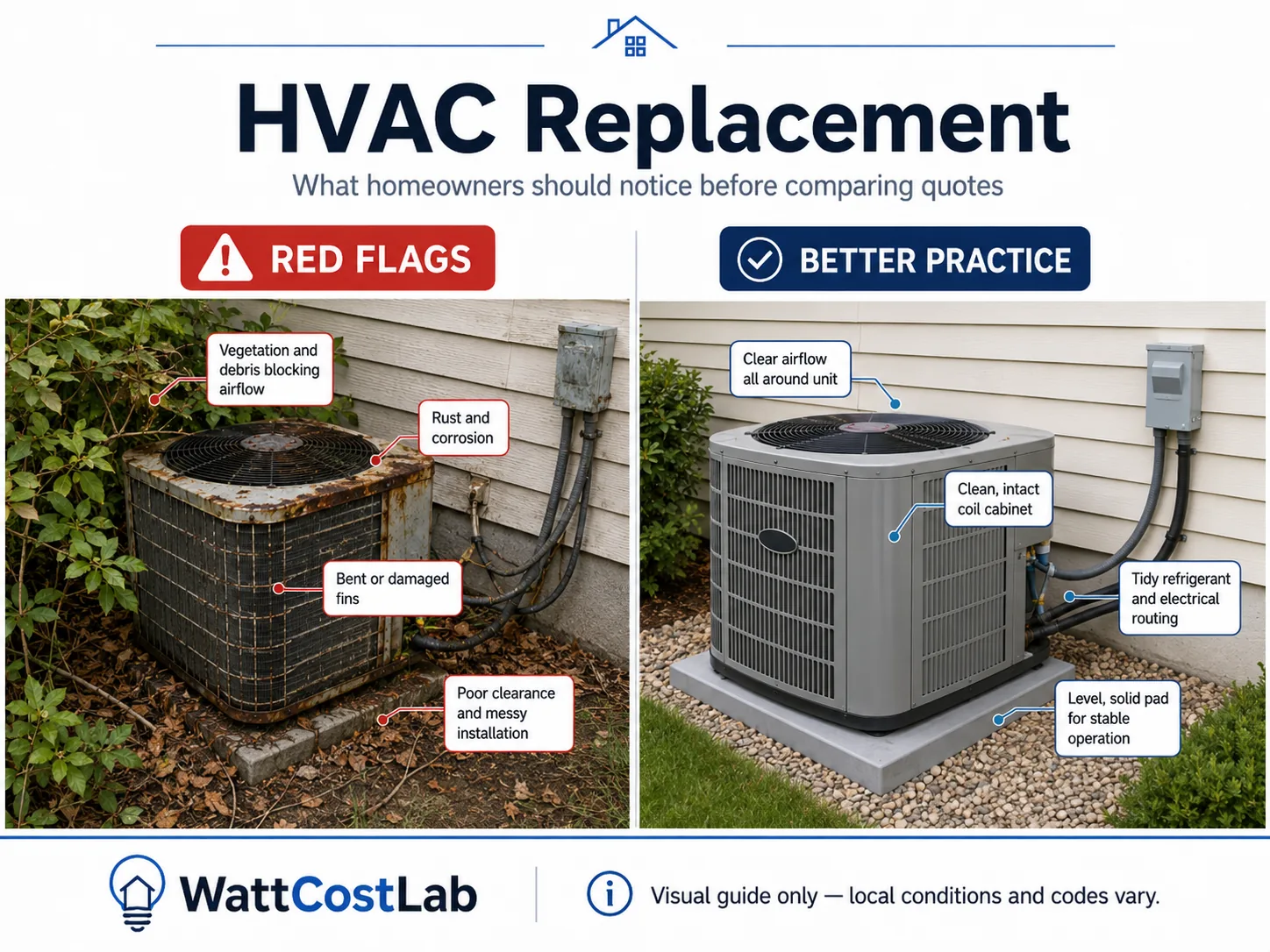
Main cost drivers
| Factor | Why it changes cost | What to ask |
|---|---|---|
| System type | Heat pump, furnace + AC, packaged unit or other configuration | What exact equipment is included? |
| Capacity | Larger equipment and accessories may cost more | Was a load calculation performed? |
| Efficiency | Higher-efficiency equipment can increase upfront price | What rated efficiency is quoted? |
| Ductwork | Leaks, poor sizing and damaged ducts add scope | Was duct condition assessed? |
| Electrical work | Breakers, disconnects, wiring or service capacity may need changes | Are electrical changes included? |
| Controls | Thermostats, zoning and communicating controls add cost | What control system is included? |
Replacement vs full redesign
A like-for-like replacement can be straightforward when the existing system was correctly sized and the ducts are in good condition. If comfort problems already exist, simply installing new equipment may preserve the underlying problem. Ask whether airflow, duct sizing and room-by-room load issues were reviewed.
How to compare contractor quotes
- Compare the same system type and similar capacity.
- Confirm equipment model numbers and efficiency ratings.
- Separate duct, electrical and control work from base equipment cost.
- Check who handles permits and inspections.
- Ask how airflow, refrigerant charge and startup will be verified.
- Compare labor and manufacturer warranties separately.
Related guides
See HVAC Installation Cost, Central Air Installation Cost, Heat Pump Installation Cost and Gas Furnace Installation Cost.
FAQs
What is included in an HVAC replacement?
A complete replacement can include outdoor and indoor equipment, controls, refrigerant lines, condensate work, electrical connections, removal of old equipment, permits, startup and testing.
Should ductwork be replaced with the HVAC system?
Not automatically. Existing ducts should be inspected for leakage, damage, airflow and sizing before deciding whether repair or replacement is necessary.
Why do HVAC replacement quotes vary so much?
Equipment efficiency and capacity, duct condition, electrical work, installation access, controls, permits and local labor can materially change the project scope.
Have contractor quotes?
Compare price, warranty, included scope and exclusions side by side.
Before you request quotes
External video
Watch: practical renovation guide
A short external video can help you understand the installation details behind the cost drivers on this page.
Project calculator: Build a transparent line-item budget →
Compare scope, assumptions and exclusions—not just the total price.
Use WattCostLab’s quote checklist before signing a contract. It helps you compare like-for-like project scope without claiming that a referral marketplace is active.
Worked example: normalize scope before comparing prices
A $10,200 proposal that includes permits, thermostat, startup and required electrical work can be cheaper on a comparable basis than a $9,300 proposal that later adds $700 of electrical work and $500 of permit and commissioning costs. In this example, the second proposal reaches $10,500 once known exclusions are added.
This is why WattCostLab recommends comparing equipment and scope line by line rather than treating the first total on a proposal as the final project cost.
HVAC replacement decision checklist
- Confirm model numbers and rated efficiency.
- Confirm sizing assumptions rather than replacing equipment solely by old nameplate size.
- Identify duct, electrical, condensate and refrigerant-line work.
- Check permits, commissioning, disposal and warranty.
- Separate optional upgrades from work required for a functional installation.
Use the HVAC Replacement Cost Calculator to organize a project budget.