Main panel capacity
Older or constrained electrical services may need panel, breaker or service changes depending on the final design.
Panel upgrade calculatorUpdated August 18, 2026
Residential solar PV cost should be compared as a complete installed project: modules, inverter architecture, mounting, roof work, electrical upgrades, permits, utility interconnection and expected annual energy production.
A useful first estimate starts with the proposed DC system size and an all-in installed price per watt. The simplest quote-based equation is:
Gross project cost = DC system size (W) × installed price per watt + project-specific add-ons
Project-specific add-ons may include roof work, electrical upgrades, trenching, structural work, monitoring, batteries or other items not included in a contractor's base price. Because local pricing changes over time, WattCostLab does not hard-code a nationwide installation price; use an actual local quote whenever possible.
Open Solar Installation Cost Calculator
| Component | What to compare | Why it matters |
|---|---|---|
| PV modules | Model, quantity, DC rating, product warranty | Determines array capacity and long-term equipment terms |
| Inverter(s) | String inverter, microinverters or hybrid architecture | Affects conversion, monitoring, battery compatibility and serviceability |
| Mounting | Roof type, attachment method, flashing, structural scope | Complex roofs can increase labor and hardware |
| Electrical | Panel capacity, disconnects, wiring, interconnection scope | Older services may need additional work |
| Permits/interconnection | Included or excluded | Administrative costs and timelines vary locally |
| Battery | Included separately or bundled | Storage can materially change project economics |
Solar modules are only one part of a grid-connected PV system. A quote may also include inverter equipment, conductors, disconnects, monitoring, utility interconnection and changes to the home's service or main panel. Ask the installer to separate these costs from the module and racking price.
Older or constrained electrical services may need panel, breaker or service changes depending on the final design.
Panel upgrade calculatorString inverters, microinverters and hybrid systems can change equipment, monitoring, battery-readiness and service scope.
Solar battery integrationPermits, inspections, meter changes and interconnection requirements should be identified explicitly in the proposal.
Electricity prices by stateTwo systems with the same installed price can produce different amounts of electricity because output depends on location, orientation, shading, module temperature, inverter characteristics and system losses. NREL's PVWatts is designed to estimate grid-connected PV production using location and system inputs and is a useful independent benchmark for checking production assumptions.
For preliminary sizing, use the Solar Panel Sizing Calculator. For financial scenarios, use the Solar Savings & Payback Calculator.
The U.S. Department of Energy and national-laboratory partners publish bottom-up photovoltaic system cost benchmarks. These are useful for understanding cost categories and industry trends, but a homeowner should still compare current local cash quotes because roof, electrical, permitting, financing and interconnection scope vary by project.
Q1-2025 Solar Photovoltaic System Cost Benchmarks — national laboratory data catalog
Suppose a homeowner is comparing an 8 kW DC system quoted at a hypothetical $3.00/W before project-specific add-ons. The base arithmetic is 8,000 W × $3.00/W = $24,000. If the same quote includes a $2,000 electrical upgrade, the gross project cost becomes $26,000 before any applicable incentives.
This is an illustration of the calculation method, not a claim about current market pricing. Replace every value with a real quote from your location.
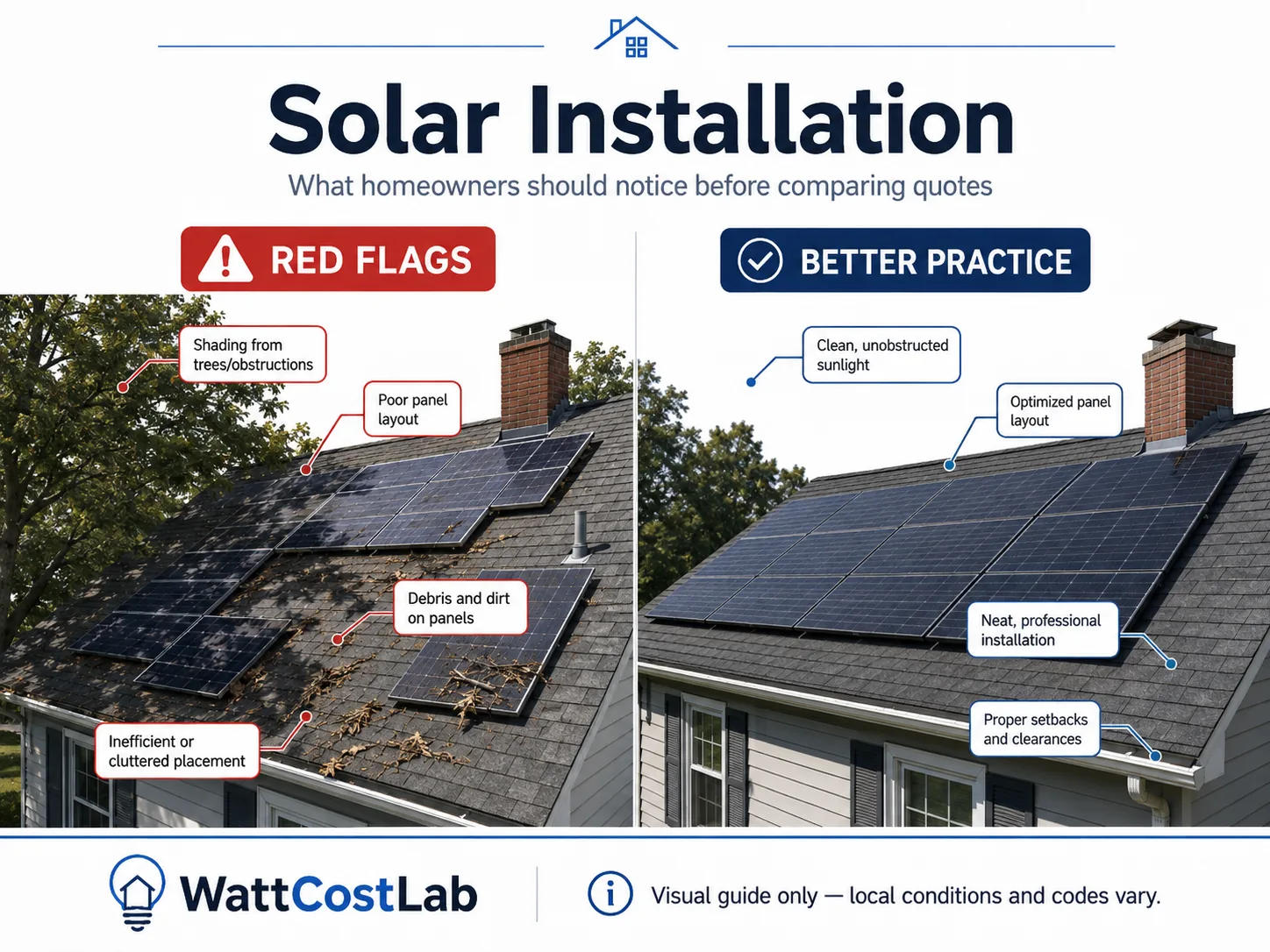
Compare the same system size, equipment, warranty terms, expected annual production, included electrical/roof work and whether the price is cash or financed.
Not automatically. Price per watt is useful only when the equipment, project scope, design quality and warranty terms are comparable.
Only if the quote explicitly includes storage. Battery hardware, inverter architecture and backup configuration should be itemized when possible.
Use net upfront cost together with expected annual production and the value of solar electricity. Exported energy may be credited differently from self-consumed energy.
Commercial disclosure: This page is editorial content. Future advertising or referral relationships will be disclosed and will not change calculator formulas or source methodology.
WattCostLab provides educational planning estimates, not contractor quotes, engineering design, tax advice or financial advice. Verify current local prices, incentives, tariffs and code requirements before making a decision.
Alternative: Compare conventional rooftop PV with Solar Roof Cost.
Compare price, warranty, included scope and exclusions side by side.
External video
A short external video can help you understand the installation details behind the cost drivers on this page.
Location-specific solar data: Use the location-based PVGIS calculator to calculate with PVGIS irradiation and PV yield for a selected city or coordinates.
Use WattCostLab’s quote checklist before signing a contract. It helps you compare like-for-like project scope without claiming that a referral marketplace is active.
Suppose two 8 kW proposals cost $22,400 and $24,000 before incentives. Their headline prices equal $2.80/W and $3.00/W. But if the first proposal excludes a required $2,000 electrical upgrade, its comparable project total becomes $24,400, or $3.05/W. Cost per watt is useful only after system size and included scope are normalized.
| Example | Quote A | Quote B |
|---|---|---|
| System size | 8 kW | 8 kW |
| Headline price | $22,400 | $24,000 |
| Known required exclusion | $2,000 | $0 |
| Comparable total | $24,400 | $24,000 |
| Comparable $/W | $3.05/W | $3.00/W |
Illustrative example: not a current national price benchmark or contractor quote. Use actual proposal values, local incentives and site-specific production estimates.
Model production and payback separately with the Solar PV Location & Payback Calculator.